publications
2026
-
 Terahertz Reflectivity Dataset: Reading Text on Both Sides of the PageGeetika Vadali, Hugo Cherid, Erwan Émile, Haolian Shi, Leor Jacobi, DS Citrin, Cédric Pradalier, and Alexandre LocquetData in Brief, Jun 2026
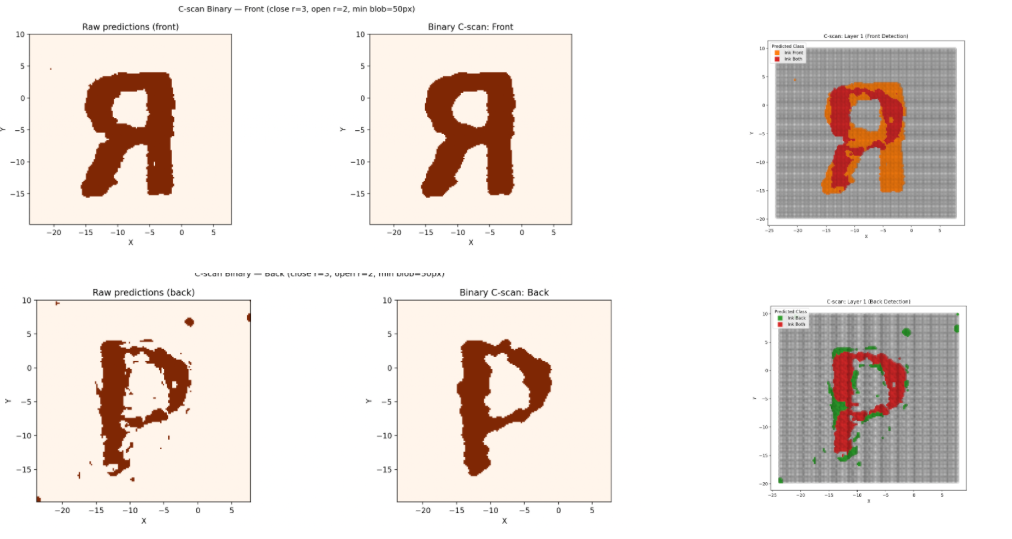
Non-destructively reading text on a sheet of paper with characters on both sides, when those characters might be obscured, unreadable visually, and the paper cannot be turned over, remains an open problem in document analysis. This problem has practical relevance to archival characterisation, fragmentology, and forgery detection. Terahertz (THz) time-of-flight tomography (TOFT) offers the ability to penetrate paper and parchment as well as sensitivity to the composition of inks. However, progress in data-driven THz analysis has been hindered by the absence of publicly available, labelled reference datasets. While a range of historical materials have been employed in manuscripts and printed books, it is favorable to phrase the problem in a way that is accessible to numerous laboratories to develop techniques to extract such texts. In view of this aim, we introduce a curated THz-TOFT dataset comprising raster-scan measurements of four distinct print/writing media (henceforth ink), namely toner, inkjet, iron gall ink, and graphite, deposited on standard copy paper. Samples were prepared from contemporary materials consisting of one sheet of standard copy paper with overlapping test patterns or characters on each side. THz-TOFT data were acquired in reflection mode under controlled, nitrogen-purged conditions, yielding per-pixel time-domain waveforms. Multiple checkerboard-style test patterns are provided per ink type, each covering four ink configuration classes: no ink, ink on the front, back, and on both surfaces. Raw data is distributed as CSV files encoding spatial coordinates, full time-domain waveforms (reflected THz electric field), and manually validated class labels. To demonstrate the suitability of the dataset for machine-learning applications, a convolutional neural network baseline is provided together with a PyTorch-compatible dataloader. This baseline is trained and tested separately for each of the ink datasets, and the predictions on unknown data are qualitatively evaluated to compare the characteristic media properties.
-
 Reinforcement Learning for Ultrasound Image Analysis: A Scoping ReviewMaha Ezzelarab, Midhila Madhusoodanan, Shrimanti Ghosh, Geetika Vadali, Jacob L. Jaremko, and Abhilash HareendranathanApplied Biosciences, Jun 2026
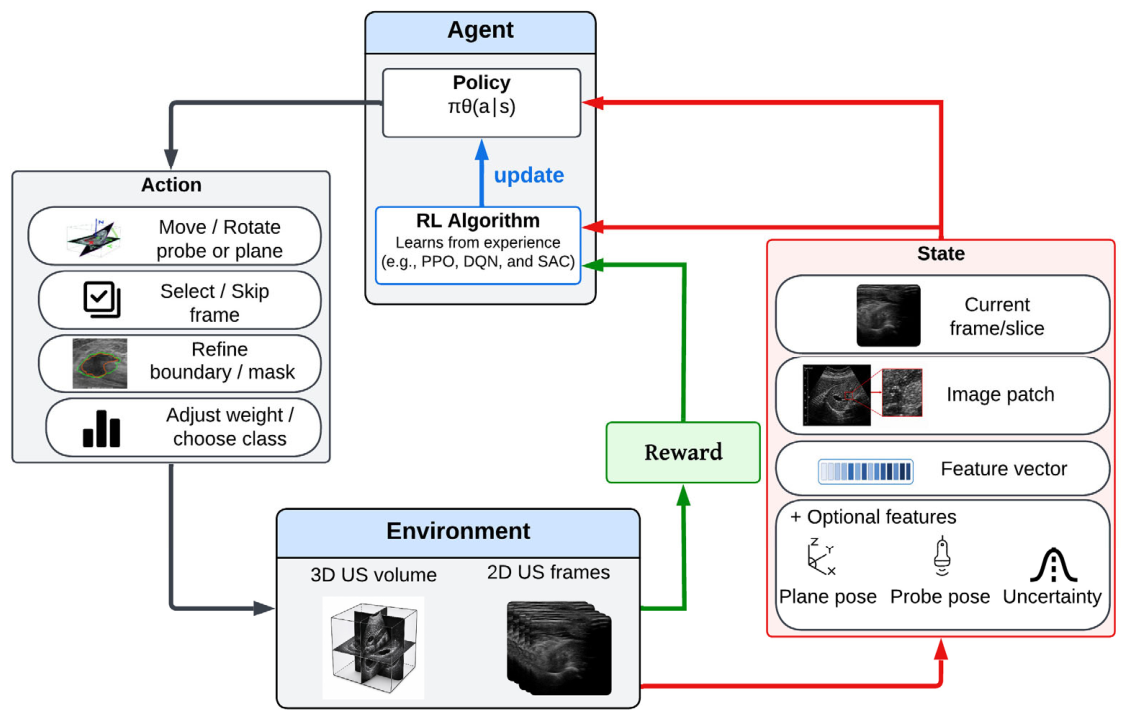
Machine learning using supervised approaches has been widely applied to ultrasound image analysis. In contrast, reinforcement learning (RL), which is well suited for sequential decision-making, is underexplored. Ultrasound workflows involve sequential subtasks like image acquisition, quality assessment, summarization, and interpretation that can be integrated into RL frameworks. This scoping review examined RL applications in ultrasound. A comprehensive search was conducted in Scopus, PubMed, Embase, and MEDLINE for studies published between 2015 and 2026. Eligible studies used RL with clinical ultrasound data, and the data were summarized by application area, methods, and anatomical targets. The review also provides a brief overview of RL concepts as foundational knowledge for understanding various RL formulations used. From 326 records retrieved, 39 studies were included. Most studies used model-free deep RL, with value-based methods being the most common, particularly Deep Q-Network (DQN) and its variants, on retrospective data across diverse anatomical targets, with breast, fetal, and uterine ultrasound being the most frequently represented categories. RL was used to automate tasks including navigation, plane localization, landmark detection, and video summarization. RL in ultrasound imaging is an emerging field of research and has advantages for sequential workflow optimization tasks. Most approaches are at an early stage and have been tested on small datasets, lack consistent evaluation protocols, and report limited clinical translation.
-
 Spatio-Temporal Crime Detection Using Surveillance Videos in a Federated SettingNikita Shrivastava, Anushka Garg, Geetika Vadali, and Ritika KumariIn Computer Vision and Robotics, Jun 2026
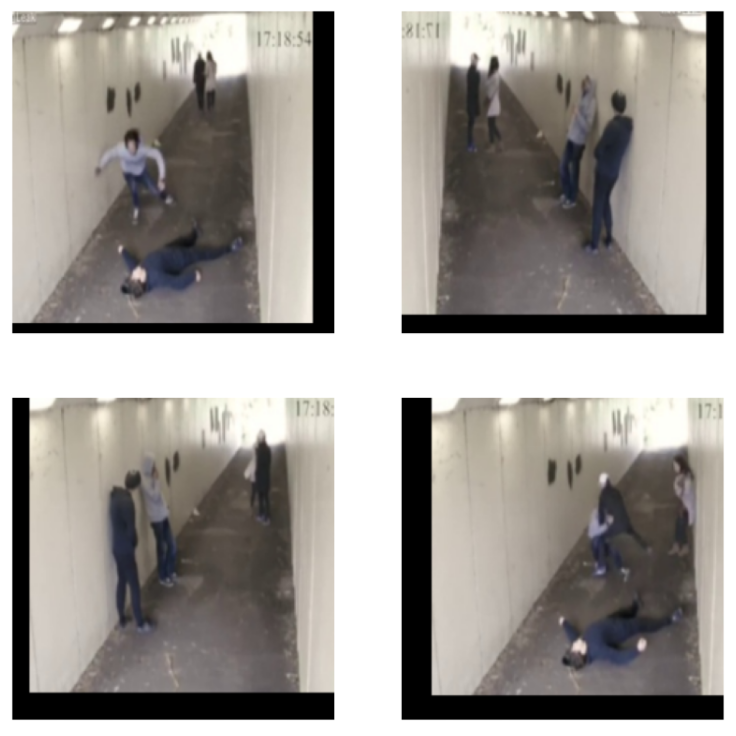
The detection and prevention of criminal and violent activities is critical for enhancing public safety. This research proposes a novel approach to using surveillance video data for deep learning-based crime detection in a federated and distributed setting. The proposed methodology leverages the SlowFast network architecture for video’s spatial and temporal feature extraction relevant for efficient violence identification and classification. By utilising federated learning, the model ensures that privacy and data security are maintained, as the surveillance videos need not leave the local devices. Models are trained collaboratively across distributed nodes, reducing the risk of data breaches in high-priority security tapes. This makes our methodology potentially scalable to real-time security systems. The results achieved through this framework outperform previous methods, in both accuracy of classification and computational efficiency. This research demonstrates the efficacy of proposed methodology by evaluating it on the UCF-Crime Dataset, where it achieves high accuracy in detecting spatio-temporal anomalies associated with crime events, while offering scalability and robustness in a decentralized environment. Extensive empirical results have shown that the proposed framework significantly outperforms traditional classification models, achieving accuracies upwards of 99% while also significantly reducing training time and computational resource inefficiency by over 240% in comparison to previously proposed spatio-temporal architectures.


2025
-
 Shoulder Rotator Cuff Tear Detection from Ultrasound Videos Using Deep Reinforcement LearningShrimanti Ghosh, Geetika Vadali, Ayush Singh, Yuyue Zhou, Banafshe Felfeliyan, Assefa Wahd, Jessica Knight, Mahesh R. Panicker, Jacob L. Jaremko, and Abhilash R. HareendranathanIn 2025 IEEE 22nd International Symposium on Biomedical Imaging (ISBI), Jun 2025
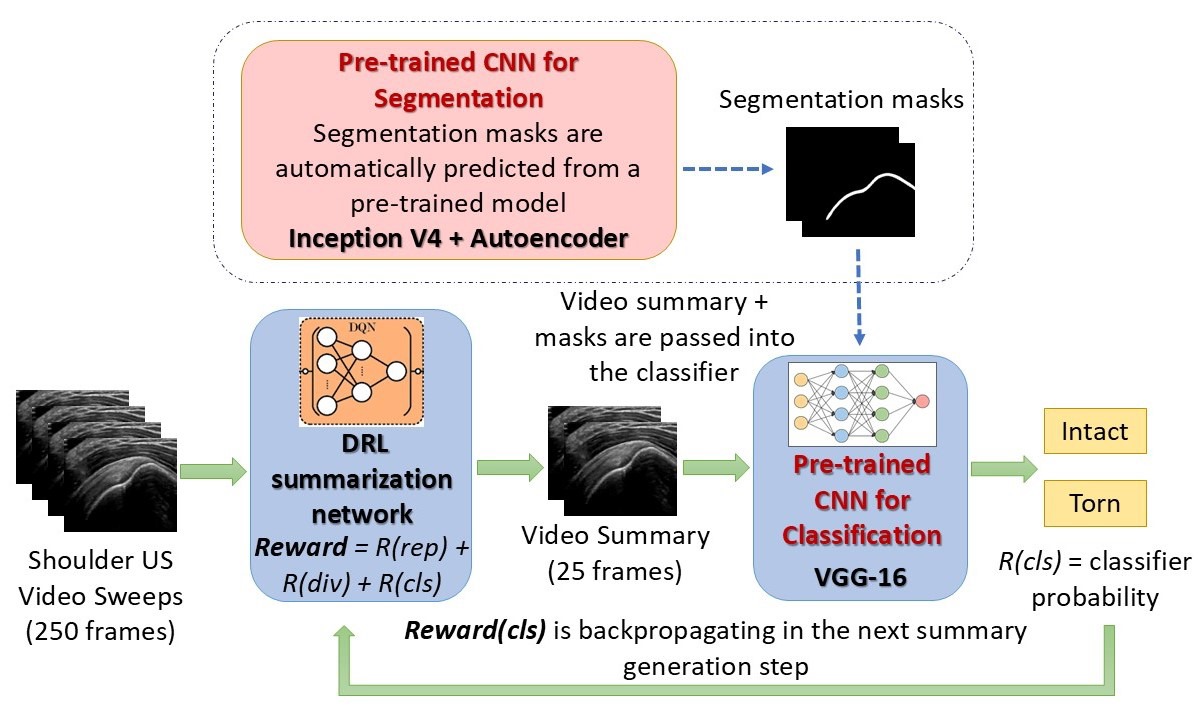
Rotator cuff tears (RCT) are common musculoskeletal injuries that significantly impact patient mobility and quality of life. Ultrasound (US) is a real-time, cost-effective tool for diagnosing RCT, offering dynamic assessment through video sweeps. However, these videos are noisy and challenging to interpret, even for experts. They are also often quite long and contain redundant frames which make it more timeconsuming for clinicians to identify key diagnostic details. To address this, we developed a novel RCT assessment technique using Deep Reinforcement Learning (DRL)-based video summarization approach, where the RL-agent mimics a human expert by analyzing the full video, selecting diagnostically relevant frames, and then using CNN to classify the frames as intact or torn. The innovative reward mechanism, emphasizing the frame dissimilarity and feature similarity, enhances the RL agent’s frame selection process. This reduces computational complexity and storage requirements, and simplifies the downstream classification task by focusing only on the keyframes indicative of RCTs. Experimental results on 100 patients demonstrate that our proposed classification network achieved 85.0% accuracy (90.0% sensitivity, 80.0% specificity) using the RL-generated video summary, outperforming full video classification accuracy of 82.5%, while also reducing the training time by 50% (from 8 hours to 4 hours) , highlighting its potential to assist clinicians in more effective diagnosis. The DRL approach developed in this work can be integrated into a low-cost US-AI tool that can reliably identify RCTs, thus improving access to imaging, providing earlier disease diagnosis and enhancing patient care.
-
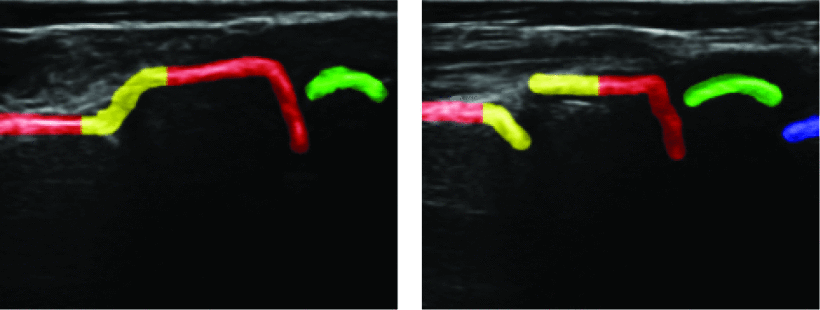 Video Summarization and Fracture Detection in Pediatric Wrist Ultrasound Using Deep Reinforcement LearningShrimanti Ghosh, Geetika Vadali, Yuyue Zhou, Ayush Singh, Jessica Knight, Christopher Keen, Mahesh R. Panicker, Abhilash R. Hareendranathan, and Jacob L. JaremkoIn 2025 47th Annual International Conference of the IEEE Engineering in Medicine and Biology Society (EMBC), Jun 2025
- Predicting Startup Exit Strategies with Ensemble Machine LearningM. Deekshitha Reddy, Geetika Vadali, Garima Jaiswal, Ritu Rani, and Amita DevIn Artificial Intelligence and Speech Technology, Jun 2025
In the current landscape, Venture capitalists are opting for more data-driven decision-making to achieve high returns while mitigating risks. All VCs seek a home run in their portfolio, for which it is essential to select the optimal exit. The process can be smoothed with the prediction of the type of exit- IPO, M&A, or the next funding round. Further,it is also to gauge which type of exit yields maximum profit for the particular climate. In this paper, through the utilisation of six machine learning models - Elastic Net, SVR, Kernel Ridge, Gradient Boost, XGBoost, and Random Forest, trained on factual data sourced from Crunchbase. The machine learning models are evaluated on the basis of 2 metrics- RMSLE and R-squared Score. We propose an ensemble learning model with Root Mean Square Logarithmic Error (RMSLE) score of 0.29 and R-squared score of 0.76. This weight-averaged ensemble has been validated to predict the optimal exit for a startup under six broad labels - IPO, Acquisition, Leveraged Buyout, Merger, Acquihire, and Management Buyout.


2023
-
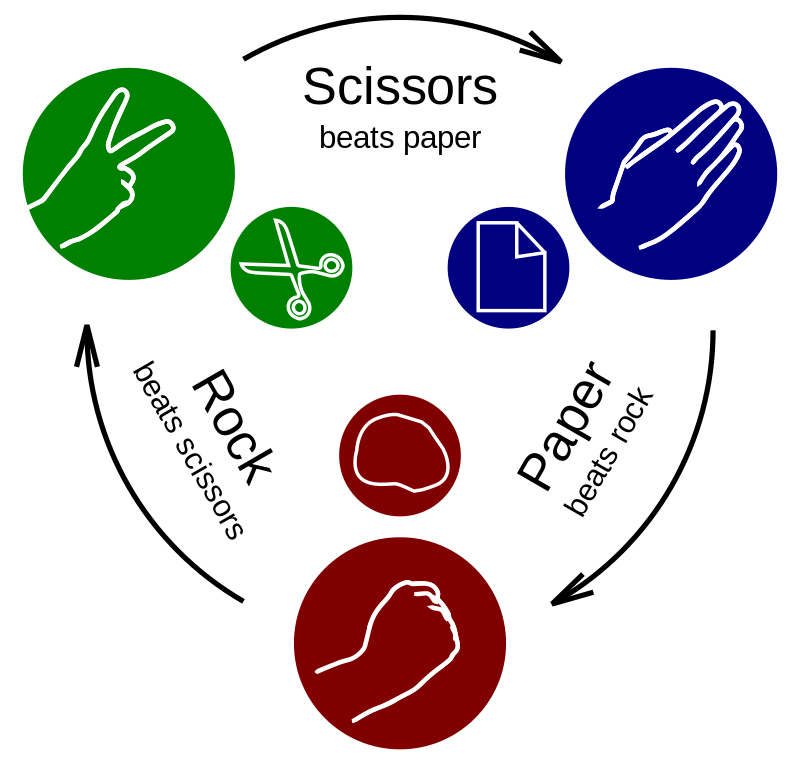 Convergence to Nash Equilibrium: A Comparative Study of Rock-Paper-Scissors AlgorithmsGeetika Vadali, M Deekshitha Reddy, Ritu Rani, and Poonam BansalIn 2023 International Conference on Computing, Communication, and Intelligent Systems (ICCCIS), Jun 2023
Rock-paper-scissors is one of the most established imperfect information games in Game theory. The Nash Equilibrium of an RPS game is relatively simple but computationally intractable; hence, various algorithms are employed to converge to a state of maximum payoff. In this paper, five algorithms, namely - Counterfactual Regret Minimization, Monte Carlo Tree Search, Q-Iearning, Deep Q-Network and Proximal Policy Optimization, have been compared on the evaluation metrics of average reward, draw ratio and convergence speed. Throughout the comparative analysis, visualising the learning curves, and qualitative comparison, Q-Iearning has shown the best convergence to Nash equilibrium for RPS.
